
Explore the Technologies
Violet Earth has developed a platform ionogel technology that transforms surfaces, soils, and structures into active climate‑repair systems with three integrated product lines:
Ionogel‑Activated Glass (IAG)
Transparent, durable, and CO₂‑active.
Converts façades, sound barriers, and walls into carbon‑capturing, pollution‑binding surfaces. Currently developing ionogel airplane windows and modifications to solar panel systems to trap and use CO₂.
Violet4Earth Soil Regeneration Film
A 4-layer composite soil regeneration film comprised of a purple starch membrane, local sourced volcanic ash layer, retinol layer and a microbial bug layer, that stabilizes contaminants, enhances microbial recovery, and increases soil carbon sequestration.
Benthic Effervescent Ocean Restoration Disks (BEORD)(BlueWorld Platform) Activated natural marine materials react to mix intrusive freshwater with sea water adding salinity, while capturing microplastics and generating micro bubbles for up to 12-18 months, lightening the oceans, oxygenating reefs, reducing wave energy, supporting marine habitat formation, and capture CO₂ in marine environments.
Together, these form the world’s first cross‑ecosystem climate materials platform.

(Click on Image to Expand)
Violet4Earth Soil Restoration
4-Composite Film
The Violet4Earth restoration system employs a stratified amendment approach: a food starch based purple film for optimal carbon entrapment, a mid-profile volcanic biochar integration zone for long-term carbon stabilization, a retinol layer nutrient substrate, and a subsurface organic amendment layer paired with a multi-species microorganism regimen based on site conditions. After fully degrading (12-18 months) the soil seems to come back to life, crawling with wonderful creatures and rich in nutrients. We have started to test a consumer planting mixture that is a really beautiful rich purple color. We are still working on the formula as a consumer end product. The more soil coverage, the more carbon we trap back into Earth's soils, the cooler and healthier the planet will be. Interesting Fact: Did you know there is no such definition globally as "dead soil" and that no country or regulatory body is keeping track of lost soil hectares per year?

(Click on Image to Expand)
Benthic Effervescent Ocean Restoration Disks
A self-consuming, multi-layer benthic reactor disk for ocean oxygen restoration and microplastic consumption. Our disk comprises five concentric functional layers (all native marine materials engineered to dissolve sequentially over a twelve-month operational period). While simultaneously addressing four critical marine environmental challenges: freshwater stratification from accelerating glacial melt, nutrient depletion in euphotic-zone surface waters, reduced ocean albedo caused by diminished phytoplankton populations, and microplastic pollution. Why bubbles? Micro bubbles actually brighten the ocean while cooling ocean temperatures. We must replace the Air Stones, bubble algae and coral reefs known for helping corals shed old trapped mucus while oxygenating the ocean. We like to call it an 'Alka Seltzer' for the ocean. If we meet our deployment targets we show a more robust AMOC and Jet Stream in Earth's near future.

(Click on Image to Expand)
CO₂‑Active Ionogel Building Façade System
Violet Earth Ionogel glass comprises a façade capture design of Purple laminated glass with a CO₂‑active layer + electrodes. This allows the system to:
Capture and bind CO₂ from ambient air within the Ionogel- which then triggers a release mode thru voltage or heat, that releases the CO₂ into a small header canopy. We then identified many ways a building owner could choose to handle their stored CO₂. Our pilot study design includes a few options, such as a building CO₂ manifold. Small pipes collect CO₂ from many panels and send it to a central unit in the building- on‑site or district‑level processing. A mineralization module then reacts with the CO₂ with alkaline materials → solid carbonates → used in concrete or stored as part of the system. An owner could also choose to take the CO₂‑to‑materials module option which sends CO₂ to a partner facility making polymers or other durable products. We will also test embodied storage with Violet Earth within the building structure itself (and associated products) resulting in the entire building becoming a carbon store, not just a lower‑emission structure. The amount of CO₂ that our façade captures per day is finite so we must size the downstream mineralization/materials system to match that flow.

(Click on Image to Expand)
Violet Earth IP Data Layers and AI in all Products
Violet Earth’s technologies are designed not only to restore soils, oceans, and air—they are engineered to measure, verify, and optimize those restoration processes in real time. Each system we deploy becomes a node in a distributed environmental intelligence network.
In soils, our films and mineral‑activated layers can embed micro‑sensors that track moisture kinetics, carbon flux, nutrient ion exchange, and microbial recovery. This creates continuous datasets on soil respiration, sequestration rates, and water retention—metrics that are essential for carbon markets, agricultural resilience, and ecological forecasting.
In the ocean, our marine‑native materials can incorporate optical, chemical, and electrochemical sensors that monitor dissolved CO₂, pH, oxygen levels, and nutrient cycling. These data streams allow us to quantify ecosystem recovery, detect early signs of collapse, and validate carbon drawdown in environments where traditional monitoring is nearly impossible.
In the air, Ionogel‑Activated Glass provides a unique advantage: every surface that captures CO₂ can also measure ambient concentrations, capture efficiency, and environmental conditions. Buildings become real‑time atmospheric observatories, generating high‑resolution climate data across entire cities.
AI is not an add‑on—it is the force multiplier that turns Violet Earth’s materials into a planetary operating system.
AI can identify early signals of soil collapse, algal shifts, or atmospheric anomalies long before they are visible to scientists.
Machine learning can tune capture rates, water retention profiles, or nutrient release kinetics based on local conditions.
AI enables automated MRV (measurement, reporting, verification), which is the bottleneck for carbon markets and climate finance.
With enough nodes deployed, Violet Earth becomes a real‑time model of Earth’s biological systems, allowing predictive management of food security, water cycles, and carbon flows.
Autonomy: Over time, AI can guide where materials should be deployed next, creating a self‑optimizing restoration network.
The Investor Lens:
This positions Violet Earth not just as a materials innovator, but as the creator of a global environmental data layer—a defensible, scalable, high‑margin asset class. Investors see not only climate impact, but a platform that integrates:
-
Climate infrastructure
-
Environmental sensing
-
Carbon markets
-
AI‑driven optimization and real‑time ecological intelligence
This is the kind of convergence investors rarely see: materials + data + AI + climate infrastructure, all in one system.
(Click on Image to Expand)
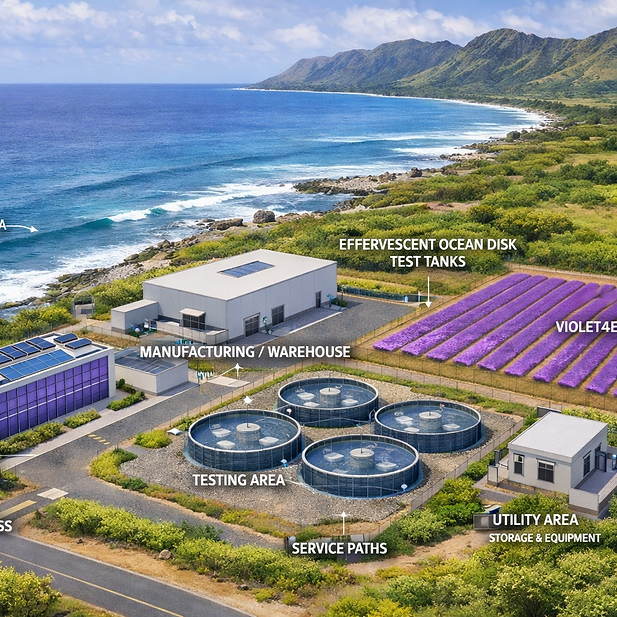
Intellectual Property Test Sites
We will purchase a 3-5 acre site of dead soil, the worst conditions possible. The location may be pre-determined by our funding sources and their agricultural needs. We hope to have 3-5 study sites in the near future, all over the world, so that we may challenge the technology in various diverse geographic locations.
These test sites and studies become our intellectual property and will provide teaching tools to students in the sciences, engineering, physics and marine biology. As well as IP and AI platform designers.
This site will provide immediate visual access of our work to investors and other interested parties such as students, local governments and regulators. We are ready for the world stage.

(Click on Image to Expand)
Where other technologies failed-
we will succeed
There is no single technology available to treat the level of atmospheric toxicity and physics problems with the AMOC and Jet Stream. These technologies also use massive amounts of energy on their own. This is why others have failed- the technology concepts are sound but every large-scale attempt has hit the same wall: energy cost per unit of albedo change vs. treatment area. We are using existing infrastructure, native materials and existing pathways to harness carbon and make it work for us instead of against us.
We also continue to have 'accidental findings' in the laboratory, for example, while creating and testing the Ionogel, we accidentally made translucent plastic like material that could replace plastic altogether. We can also modify existing solar panels to absorb and use carbon as energy. We will circle back to these concepts later, for now we are focusing on these immediate concerns in our environment. We can imagine the possibilities.